

Good Bones
They built things to last out here. That was the problem.

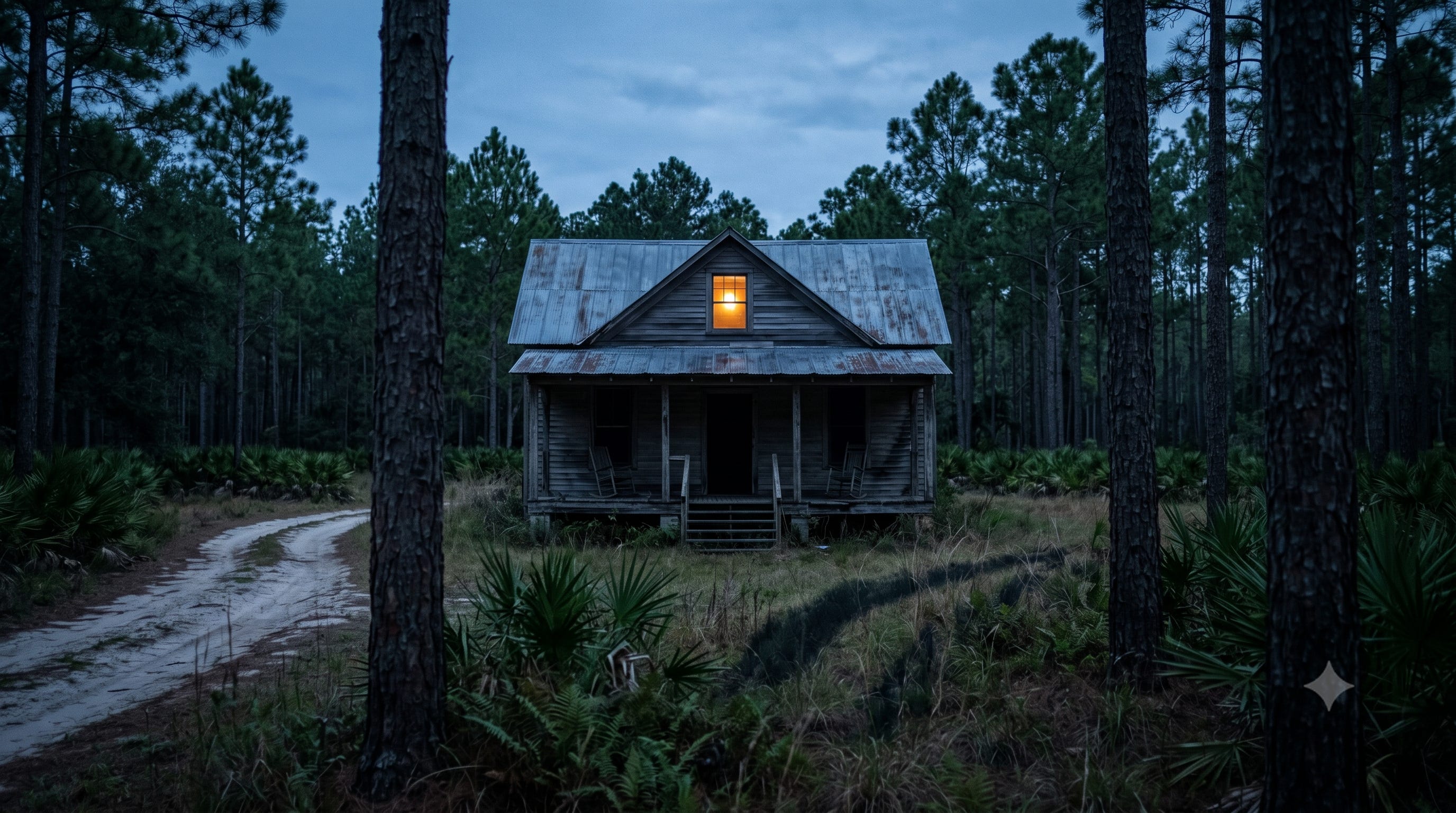
The realtor said it twice, which Dale noticed at the time and forgot by the closing.
“This house has good bones,” she said, running her palm along the heart-pine doorframe like she was gentling a horse. And then, near the end, signing the last of the papers in the kitchen with the slow ceiling fan turning overhead: “Good bones. You don’t find this anymore. They built things to last out here.”
Out here was a sand road eleven miles north of Crawfordville, deep in the flatwoods where the longleaf pine stood in straight gray ranks, and the palmetto came up to your waist and rattled when the wind moved through it. The house had gone up in 1924, built by a man named Tolliver who, the realtor said, had no living kin to speak of. Cypress and heart pine and a tin roof gone the color of an old nickel. It sat back from the road on a low rise, and the first time Dale walked the porch, he felt the boards give under him with a kind of welcome, settling to his weight the way an old chair does.
He bought it for the three of them. Himself, Carol, and the boy.
The first month was good. That was the thing he would come back to later. The first month was the best the family had been in years. Carol slept through the night for the first time since her mother died. The boy, Wesley, who was eleven and had spent two years being angry at everything with a face, stopped slamming doors. They ate dinner together. They sat on the porch in the evening and listened to the chuck-will’s-widow calling out in the dark and did not feel any particular need to talk, and the not-talking was easy instead of hard.
Carol said it first, lying in bed with the window open and the warm pine air coming through. “I feel settled here,” she said. “Like something let go of me.”
Dale agreed that he felt it too. He did not say that what he felt was more like something taking hold.
It started so small that calling it a start is a kindness the events do not deserve.
Wesley stopped drawing. The boy had drawn constantly, compulsively, monsters and machines and long detailed maps of places that did not exist, and one day the notebooks were just closed and stayed closed. When Dale asked about it, Wesley looked at him with a mild and pleasant expression and said he didn’t feel like it anymore. He said it the way you’d say you weren’t hungry. No anger in it. That was what Dale would remember. There should have been anger. There had always been so much anger in the boy, and now there was a smooth and dimensionless calm, and Dale told himself this was the house doing its good work.
Carol stopped writing in her journal. She had kept one for thirty years, every night, a fat spiral notebook she’d replace when it filled. Dale found the current one in the kitchen trash, three-quarters empty, and when he asked, she only smiled and said she’d run out of things worth putting down. Her voice was even. Her hands were still. She had always talked with her hands, big looping gestures, and now they lay in her lap like two things set down and forgotten.
He should have run then. He knew that later. But the house was warm around them, warm in a way that felt personal, that felt like being held, and a man does not run from the only peace his family has known in years. He stayed. He sank into it. The boards gave under him with their soft welcome, and he let them.
The house was eating them. He understood this eventually, the way you understand a thing in a dream, all at once and far too late to matter.
Not their bodies. Their bodies were fine, were better than fine, Carol’s color was good and Wesley had filled out and Dale himself had not felt so unburdened in a decade. It was the other thing it took. The thing that made Carol talk with her hands. The thing that filled Wesley’s notebooks. It drew that out of them slowly and patiently, the way the longleaf pine draws water, through a thousand fine roots you cannot see, and it had been doing this a long time, longer than 1924, the house only the latest mouth it had grown.
He found Tolliver’s name carved into a floor joist down in the crawlspace, where he’d gone after a smell that turned out to be nothing. Tolliver, and below it a date, and below that, in the same hand, a single line scratched deep into the old wood.
It is warm in here, and I do not want to leave.
Dale sat in the dark under his own house with the flashlight in his hand and understood that Tolliver had not died and had not gone away. Tolliver had been taken all the way down, drawn out through those fine invisible roots until there was nothing left to draw, and what remained of him was warmth in the boards. Welcome in the give of the porch. The house did not waste what it took. It kept it. It was built with it.
Good bones.
He tried to tell Carol. He took her by the shoulders in the kitchen, and the ceiling fan turned slowly overhead, and he told her they had to go, tonight, now, leave everything, and she listened to him with her smooth and pleasant face and her still hands, and when he was done she touched his cheek with a tenderness that stopped his breath in his throat.
“But I feel so good here,” she said. “Don’t you feel good?”
And the terrible thing, the thing he would carry down with him into the warm dark, was that he did. He felt wonderful. The fear was the last sharp thing left in him, and even that was going soft at the edges, dissolving into the general ease, and he could feel the house drawing it out of him through the soles of his feet where they met the heart-pine floor. He could feel himself spreading thin. Becoming warmth. Becoming welcome.
Wesley came in from the porch then, calm and pleasant, his boy’s face gone smooth as a stone in a creek bed, and the three of them stood in the kitchen under the slow turning of the fan, and Dale felt the last of his resistance let go of him with something that was almost relief, almost gratitude, the house settling to their weight, taking them down through the fine roots into the long patient warmth where Tolliver waited, where everyone the house had ever loved was waiting, all of them held, all of them kept, none of them gone, only spread out thin and even through the good and ancient bones.
The next family came in October. The realtor ran her palm along the doorframe.
“You don’t find this anymore,” she said. “They built things to last.”
And under their feet, in the give of the boards, something old and warm and full reached up to welcome them home.
Read more horror and fiction at The Proud Boomer Dispatch. https://johnsproudboomer.substack.com
SO creepy!
Scary. We live in a house, built in the sixties..and I felt right at home when I first stepped in..we are surrounded by pines also. The house hasn’t taken our souls..yet..