

Hollow Ground
A Utah highway in February

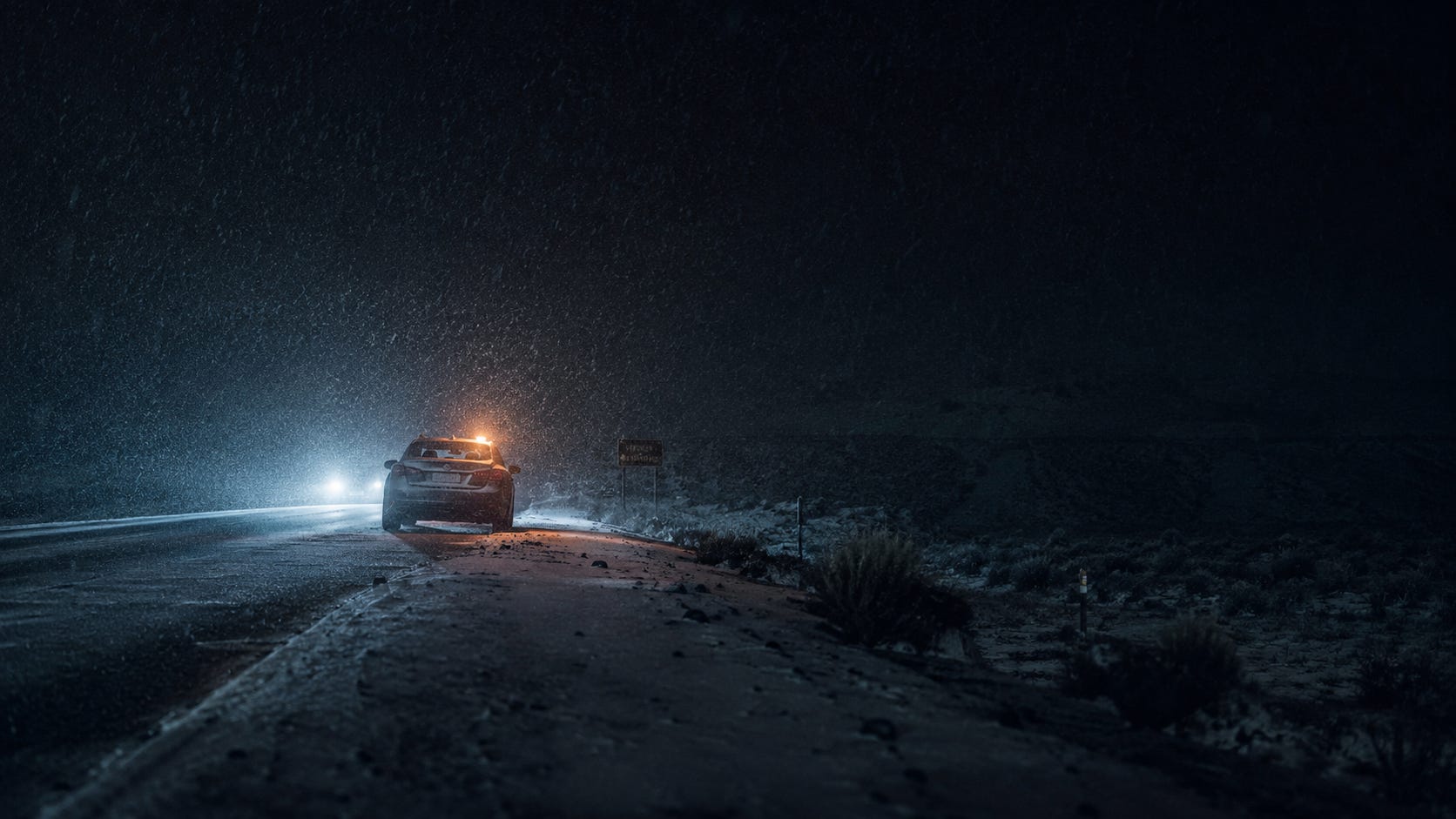
The sign said Millard County Road 12, but the county had apparently stopped maintaining it sometime around the second Bush administration. Ray Delvecchio sat at the intersection for forty seconds with his hazards blinking, watching the snow come sideways across the headlights, and thought: somebody put that sign there for a reason.
He turned left anyway.
He was forty-one years old. He sold agricultural equipment. He had a wife in Provo who had recently stopped answering his calls before nine p.m., which was not a good sign, and he had chosen not to think about it until he could think about it somewhere warm. The drive from Cedar City should have taken two hours. It was now going on four, and I-15 had closed somewhere around Fillmore, and the detour app on his phone had routed him onto roads that felt less like roads and more like guesses.
The headlights lit about thirty yards of white in front of him. Beyond that, nothing. The kind of dark that has weight to it. Utah desert in February at 11 p.m. is not a place that wants you there. The silence, when he cracked his window, was the silence of a room after someone has just stopped screaming.
He almost missed the car.
It was a 2009 Subaru Forester, salt-gray, pulled off on the right shoulder with its emergency flashers going. One taillight was out. The other pulsed orange in the snow like a warning that had given up being urgent. Ray slowed. He did not stop. He drove past it at five miles an hour and looked in the rearview and saw no movement, no shape behind the glass, nothing. Just the one orange pulse.
He drove another quarter mile.
He stopped.
“The decent thing,” he said to himself. He had been saying that to himself his entire life, and it had gotten him into a bad mortgage, a worse business partnership, and, now apparently, a county road in the middle of a Utah whiteout at eleven-fifteen on a Tuesday night.
He reversed. He pulled up behind the Forester, kept his headlights on, and got out.
The cold was not cold the way January in Ohio is cold. This was cold the way a held breath is cold, a kind of cold that has intention. It hit him in the face and made his eyes water immediately. His boots punched through the snow crust and sank four inches. He knocked on the driver’s window.
The woman inside was in her mid-fifties, maybe. Silver hair cut short. She was sitting fully upright, hands in her lap, not gripping the wheel, not reaching for her phone. She was wearing a heavy wool coat the color of dried blood. She turned her head toward him slowly, the way a person turns their head when they already knew you were coming.
“Battery,” she said, through the glass.
He opened the door. The interior light came on.
He saw her hands.
He would tell himself, later, that he had been mistaken. That the light was bad. That the shadows in the car played tricks. That fingers do not look like that, not on a living person, not on a person who is talking to you and asking for a jump and apologizing for the trouble.
Her hands were in her lap, palms up, and the fingers on the left hand were wrong. Not broken-wrong, not frostbite-wrong. The skin had gone the color of old wax, and where her knuckles should have been, there was a smoothness, a sort of settling, as if the joints underneath had dissolved and the skin had simply closed over the absence. The ring finger was shorter than it should have been. Not cut. Not injured. Shorter, the way a candle gets shorter, the way things get shorter when they are consumed from the inside.
“Do you have cables?” she asked.
He said yes. He got the cables. He hooked them up. His hands were shaking and he told himself it was the cold. She stayed in the car. She did not look at her hands. She looked straight ahead through the windshield at the snowfield beyond the headlights, and her expression was not distress or pain or fear. Her expression was the particular blankness of someone who has accepted a thing that has not finished happening yet.
Her car started on the second try.
“Thank you,” she said. Her voice was clear and even. “You should go. Don’t stop again on this road.”
He wanted to ask her something. He could not find the question.
“Is there someone I can call for you?” he said instead.
She smiled at him. The smile was fine. The smile was perfectly normal. And then, because the interior light was still on, he saw that her right hand, which had been closed in her lap when he first looked, was now open. And the palm was smooth. No lines. No creases. The surface of the palm was flat and unmarked the way skin is flat and unmarked when it has finished with everything it was supposed to do.
“I’m being met,” she said.
He drove for six miles before he pulled over.
He sat with the heat running and thought about what he had seen with great discipline and care, the way a person dismantles something they do not want to be true. Bad light. Shadows. His own exhaustion. The cold made things look different. The cold did things to skin. He had read that somewhere, or close enough to somewhere that it counted.
He thought about the smoothness of her palm.
He thought about the word met.
He pulled back onto the road and did not stop again. He reached the highway at 12:40 a.m. and drove to a Super 8 in Holden and paid cash because his card was probably maxed and lay on top of the bed in his coat and stared at the ceiling and told himself he would not think about it anymore tonight. That was the decision he made. That was the decision that felt, in the moment, like the only reasonable one available to a man who sold agricultural equipment and had a wife in Provo and needed to get through to morning.
He woke at 3 a.m. to the feeling of his left hand on the mattress beside him.
He did not want to look at it. He lay completely still for a long time with his eyes on the ceiling and the room very quiet around him, the heater clicking, the highway outside, the absolute absence of any other sound. He thought about the woman’s face when she turned toward him. How she had already known. How the knowing had been in her the way bad news is already in a room before anyone says it out loud.
He moved his fingers.
He felt them move.
He did not look at his hand.
He would look at his hand in the morning. In the daylight. When things looked like what they were. He lay with his eyes open and his left hand flat on the mattress beside him and listened to the heater click and told himself he would look in the morning.
Outside, on the county road, six miles from the Super 8, the Subaru Forester sat on the shoulder with its one taillight blinking. The engine was off. The interior light was off. The woman was gone.
The snow had filled her footprints so completely that there was no evidence she had ever opened the door.
If this kind of fiction is your thing, you’re in the right place. Follow the Proud Boomer Dispatches on Substack for the weekly newsletter, fiction, and opinion essays. Florida Stories Substack is where Loretta Faye lives, along with whatever else crawls out of this state. Paid subscriptions are $8/month or $50/year. Full archive, one exclusive piece per month, no sponsored content, no algorithm. Reach out at john@theProudBoomer.com
SO creepy. I love it!
“ he told himself he would not think about it anymore tonight.” I tell myself this same thing every time I read one of your stories!