
Midnight, Room 7
Alone and Lonely are two separate things

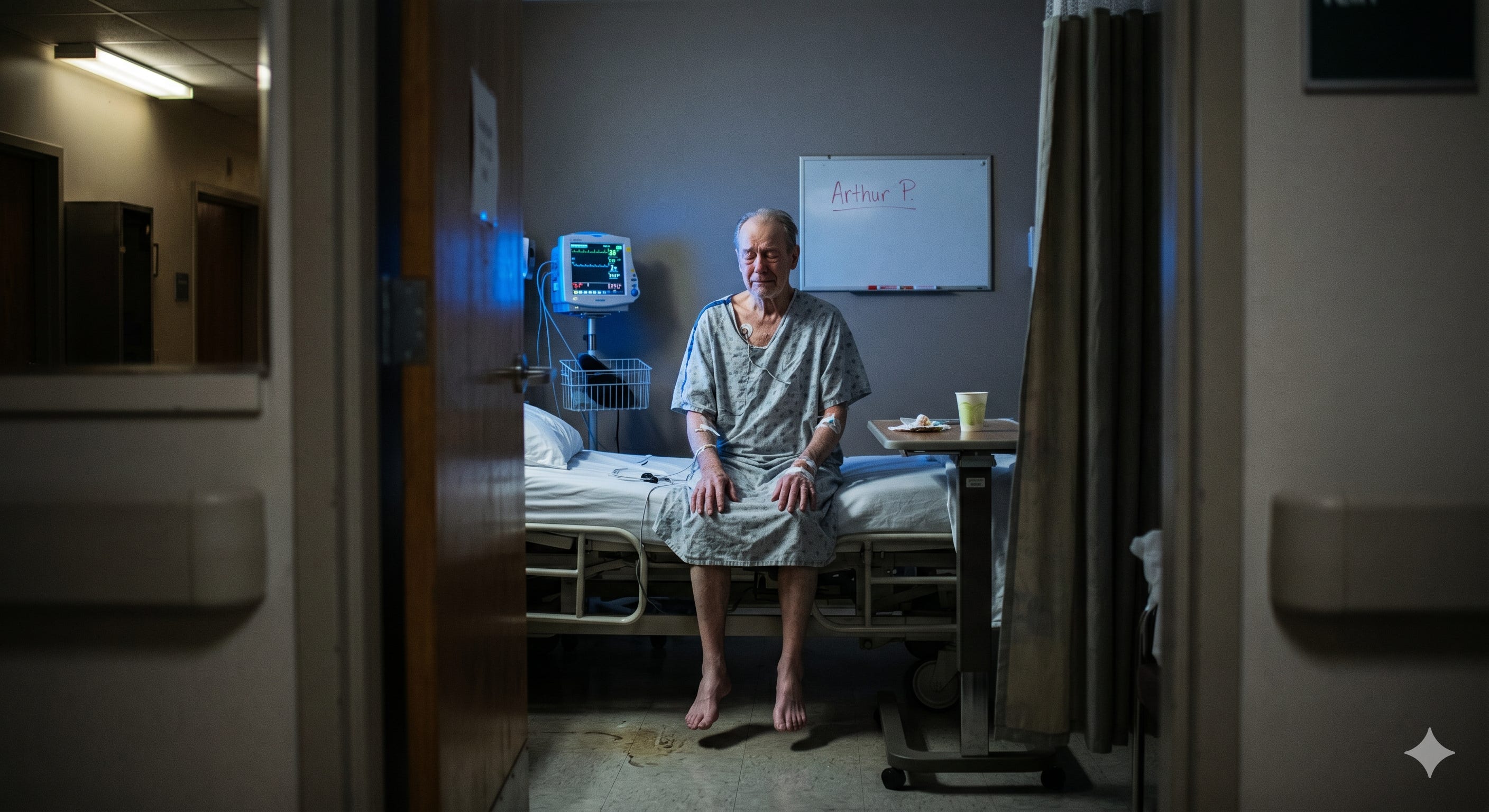
The fluorescent light above bed seven had a flicker nobody had fixed. Not a dramatic strobe, just a slight, irregular pulse, the kind you only noticed when you’d been staring at the ceiling long enough. Ray had been staring at it for four hours.
He’d sent Carol home around eleven. She had argued, the way she always argued, standing with her coat half-on, trying to appear casual about staying. He told her the nurses were good, which was mostly true, and that he’d sleep, which was not true at all. What he didn’t tell her, what he had known since sometime around nine o’clock when the doctor’s face did a thing doctors’ faces do when they’ve stopped negotiating with the numbers, was that he didn’t want her in the room when it happened. Forty-one years of marriage and he was going to spare her the last thirty seconds of it. That was the only gift he had left to give her, and he had given it dressed up as practicality, and she had taken it because she trusted him, and that had nearly broken him right there in front of her.
She had kissed his forehead and walked out the door, her heels making that particular sound on hospital tile, and he had listened until he couldn’t hear her anymore.
His nurse’s name was Gwen. He knew this because it was on the whiteboard across the room in red marker. NURSE: GWEN. She had introduced herself when she came on shift, shaken his hand once, efficiently, and then set about doing things to him with the practiced speed of someone who had learned that bedside warmth and clinical competence were not always the same job. She was good at the second one. Blood pressure, IV line, vitals, medication reconciliation, each task executed and logged before he could formulate a question. She wasn’t cold. She was just fast, and he was just slow tonight, and the two of them had not yet found the same frequency.
The machines kept their own time. The cardiac monitor beeped at roughly 74 beats per minute, meaning it beeped about once a second and had beeped approximately 14,400 times since he arrived. He had not counted. But he was aware of every one.
It started in his hands.
A tremor, fine and involuntary, like the needle of a compass trying to find north in a room with too much metal. He looked at them, his hands, lying flat against the thin hospital blanket, and watched them shiver. Not cold. The room was actually too warm. He pressed them flat against his thighs and the shaking was still there, transmitted through the fabric, a fact rather than a symptom.
He wanted to get up. That was his first instinct, the one he’d had since he was twelve years old, when the thing to do with fear was to move through it, to pace a hallway or circle a block until the adrenaline found somewhere to go. But the telemetry lead ran from the electrode on his chest to a transmitter clipped to the bed rail, and the IV line ran from the back of his left hand to a bag hanging above him, and the pulse oximeter on his finger connected to the monitor with a cord just short enough to be annoying. He was, in the most literal sense, tied to things.
He sat up slowly and swung his legs over the side of the bed. That much was allowed. The cold air from the floor hit his bare feet and he sat there on the edge of the mattress, and that was when it arrived. Not gradually. All at once, the way a room changes when the power goes out.
Afraid. Lonely. Miserable. Three words in the wrong order because afraid came last, after lonely and miserable had already set up camp. The lonely was harder to name because Carol had just left and the nurse was twenty feet away at her station and he was not technically alone. But lonely is not the same as alone. Lonely is the feeling of being the only one inside your particular skin at a particular moment, and no amount of other people in a building solves that.
The afraid arrived without a specific object, which was the worst kind. Except that wasn’t quite right. He knew what he was afraid of. He was afraid it would hurt. He was afraid Carol would blame herself for leaving. He was afraid of the nothing that might come after, and equally afraid of something, because something meant accountability for a life he’d lived imperfectly and with great enthusiasm.
He felt the tears before he understood what was happening. Just a welling, a spillover, the way a glass fills past its capacity so gradually you miss the moment it happens. He sat on the edge of the bed with his hands shaking and the monitor beeping once a second and his feet not quite reaching the floor, and he cried the way men of a certain age cry when there’s nobody watching, quietly and without architecture.
He did not hear Gwen come in. He only registered her when she set something on the tray table, and he turned, prepared to apologize or explain himself.
She didn’t look at him the way he expected. She didn’t look away either. She pulled the chair from the corner and sat down in front of him, close enough that she was inside whatever circle a person draws around themselves when they’re falling apart.
“I know,” she said.
She hadn’t asked what was wrong. She hadn’t said it’s going to be okay. She said I know, and she meant the specific weight of it, the midnight and the shaking hands and the wife who had just walked out on good advice and the fluorescent flicker and the thing the doctor’s face had done at nine o’clock. She meant all of it without naming any of it.
They sat there for a few minutes. He stopped crying the way you stop when someone has given you permission to have started.
She handed him a small cup of water, the waxy kind, and he drank it. She stood, moved the chair back to the corner, checked the IV line, and looked at him one more time before she left.
“Call light’s right there,” she said.
He nodded. She walked out. The curtain settled behind her.
He lay back and looked at the ceiling. The light flickered its irregular pulse and he watched it and felt, underneath the fear and the loneliness and all the rest of it, something else. Quiet. The specific quiet of a decision already made, a thing already set in motion, a train already past the last station where you could have gotten off.
He thought about Carol at home by now, her coat hung on the hook by the door, making tea she wouldn’t finish. He thought about their first apartment, the one with the broken radiator that clanged all winter, and how they had laughed at it instead of complaining because they were twenty-four and everything was still funny. He thought about his daughter’s face at eight years old, gap-toothed, furious, convinced the world had wronged her over something he couldn’t even remember now. He thought about a morning in July, years back, standing in the yard before anyone else was awake, coffee in hand, the specific smell of Florida summer before the heat made it serious. He had not known that morning was remarkable. He knew it now.
He had not lived a perfect life. He had lived a specific one, with specific people, in specific rooms, at specific times of day, and the specificity of it, the sheer irreducible particularity of having been Ray, in this body, on this earth, struck him now not as something to grieve but as something that had, against considerable odds, actually happened.
It had happened. All of it.
His hands had stopped shaking. He noticed that without moving them, the way you notice when a sound you’d stopped hearing has finally gone silent.
The monitor beeped. The light flickered. Outside the curtain, somewhere down the hall, a cart rolled past with its small, institutional noise.
Ray closed his eyes.
He took a breath, slow and full, the kind you take when you have decided to be finished fighting something, when the fighting itself has become the last thing worth letting go. His chest rose. It fell.
The line went flat.
The monitor held its single, steady tone, and the fluorescent light above bed seven kept its imperfect pulse, indifferent and faithful, the way light is.
Read more by following us at the Proud Boomer on Substack for the Newsletter, Fiction, and Opinion Essays, or on Medium for Health and Wellness. Paid subscriptions are open. You get the full archive and one exclusive piece per month. Five dollars a month or $50 per year. No sponsored content, no algorithm, just more of this. Reach out directly at john@theProudBoomer.com.
Exceptional writing John.
Oh my.