

The Column
The Long Way Around

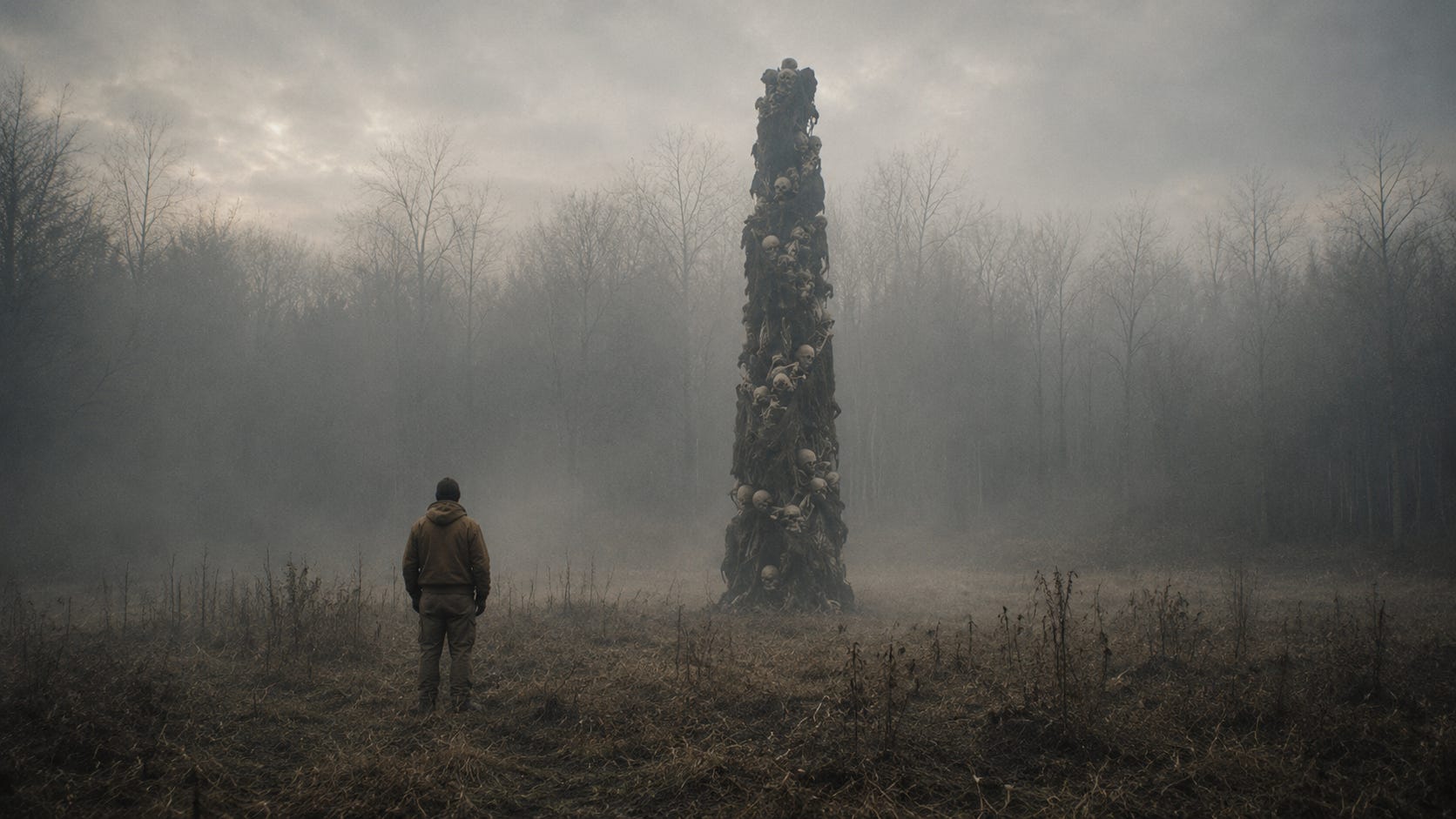
Denny Pruitt had been pulling line for Georgia Power since 1987, and in all that time he had learned two things about the backcountry between Vidalia and Uvalda: the roads were strange, and the trees always remember.
He was not a superstitious man. He was a man who wore the same jacket from October to March, who ate his lunch in the truck with the radio off because he liked the quiet, who had watched two co-workers get thrown thirty feet by live wire and come back to work the following Monday. He believed in voltage and load ratings and the particular smell of a transformer about to blow.
He did not believe in much else.
That changed on the morning of November 4th, when he drove the service road off Route 23 to check a dead span near the Odum tract, and found the column standing at the edge of the tree line.
He almost didn’t stop. He almost filed it somewhere in the back of his mind with all the other strange things you see in Georgia timber country, the hog blinds and the kudzu-buried tractors and the occasional cross made from fence wire. But he stopped, because what he saw was not like those things.
It stood maybe twelve feet tall, black and narrow, rising out of the dead grass like something the ground had been holding down and finally let go. The robes, if that’s what they were, hung in layers down its length. Faces clustered along it in ascending rows. Not carved. Not painted. Bone-white skulls set into the mass of it, tilted at angles that suggested they had come to rest there the way things come to rest at the bottom of water. Some faced outward. Some did not.
Denny sat in the truck with the engine running for what he would later estimate as four minutes, though it felt longer.
He got out.
The morning was cold and gray and the trees behind the thing were bare. A fog had come in and it moved low across the grass and made the column appear to float. There was no sound. No highway noise, no crows, nothing. Just the idle of his truck behind him and the white column of his breath in front of him.
He walked to within twenty feet and stopped.
The faces were real. That was his first clear thought. Not props, not resin, not the kind of thing some art school kid would haul out here on a dare. Real bone. Real teeth, where there were teeth. The dark material binding them was not cloth, or if it was cloth it had been there long enough to become something else, something that had taken on the texture and color of the bark behind it.
He counted eleven. Then stopped counting.
What stopped him was the face at the top.
It was higher than the others, set above them the way a figurehead sits above the waterline. It did not face forward like the rest. It faced down. And the angle of it, the particular tilt of that skull toward the ground below, toward the place where the roots of the thing disappeared into the earth, made Denny feel that he had interrupted something. Not a display. A vigil.
He took a step back.
He did not run. He walked backward until his heel found the running board of his truck, and then he got in, and then he backed down the service road the quarter-mile to Route 23 without turning around.
He called the office and told them the span near the Odum tract was inaccessible, access road washed out, they’d need to reroute the crew.
He drove to the Pilot station on 23 and drank two cups of coffee and read a three-day-old newspaper without absorbing a word of it.
That evening he told his wife he’d had a rough day on the road. She asked if he wanted to talk about it. He said no. She brought him a beer and sat next to him on the couch and they watched the news.
He went back the next morning. He told himself it was to get the actual coordinates for his report. He told himself this was the reason.
The service road was empty. The tree line was where it had been. The dead grass ran right up to the first row of pines without interruption, and the fog was gone, and the column was gone, and the earth where it had stood showed no sign, no disturbed soil, no impressed roots, nothing that would tell you anything had ever been there at all.
He stood at the tree line for a while.
Then he got in his truck and drove to the Odum span and fixed the line and filed his report and went home.
He has not driven the Route 23 service road since. When the dispatch sends him that direction, he takes the long way around through Lyons, adds forty minutes to his day, says nothing about it.
His wife has noticed that he now sleeps with the light on.
He has not told her what he saw. He is not certain what he saw. He is only certain of the face at the top, the angle of it, the way it bent toward the earth below with something that was not quite attention and not quite patience but lived in the country between the two.
He thinks about it most in November, when the fog comes off the bottomland and the trees go bare and the mornings get quiet in a way that the rest of the year doesn’t prepare you for.
He has never told anyone.
The Proud Boomer Dispatch publishes horror fiction, personal essays, and Southern Gothic stories that linger. If this one stayed with you, consider subscribing at johnsproudboomer.substack.com for $20/month or $80/year. And if you’re looking for something that’ll push you in a different direction entirely, my book Not Done Yet is on Amazon: https://amzn.to/4ed2Td6
Good grief! Now the fog will creep me out too. I will be looking around to make sure there isn’t a column. When people ask why I refuse to leave my house, I will blame you! And now, of course, you will write a scary story about something in my house. Ack!
Terrifying. I really could see the column rising from the fog. No wonder he takes the longer route, and never tells about the column. To anyone.
(I saw many real skulls and bones in the catacombs under Paris.. was traveling with a friend and she insisted on going to see them, I went along, thinking that it would be over soon..nope it just kept going on and on the skulls stared at me..)