

The Glass Between
A girl at a second-floor window, eleven feet of dark under her bare feet, and one clean eye in a ruined face

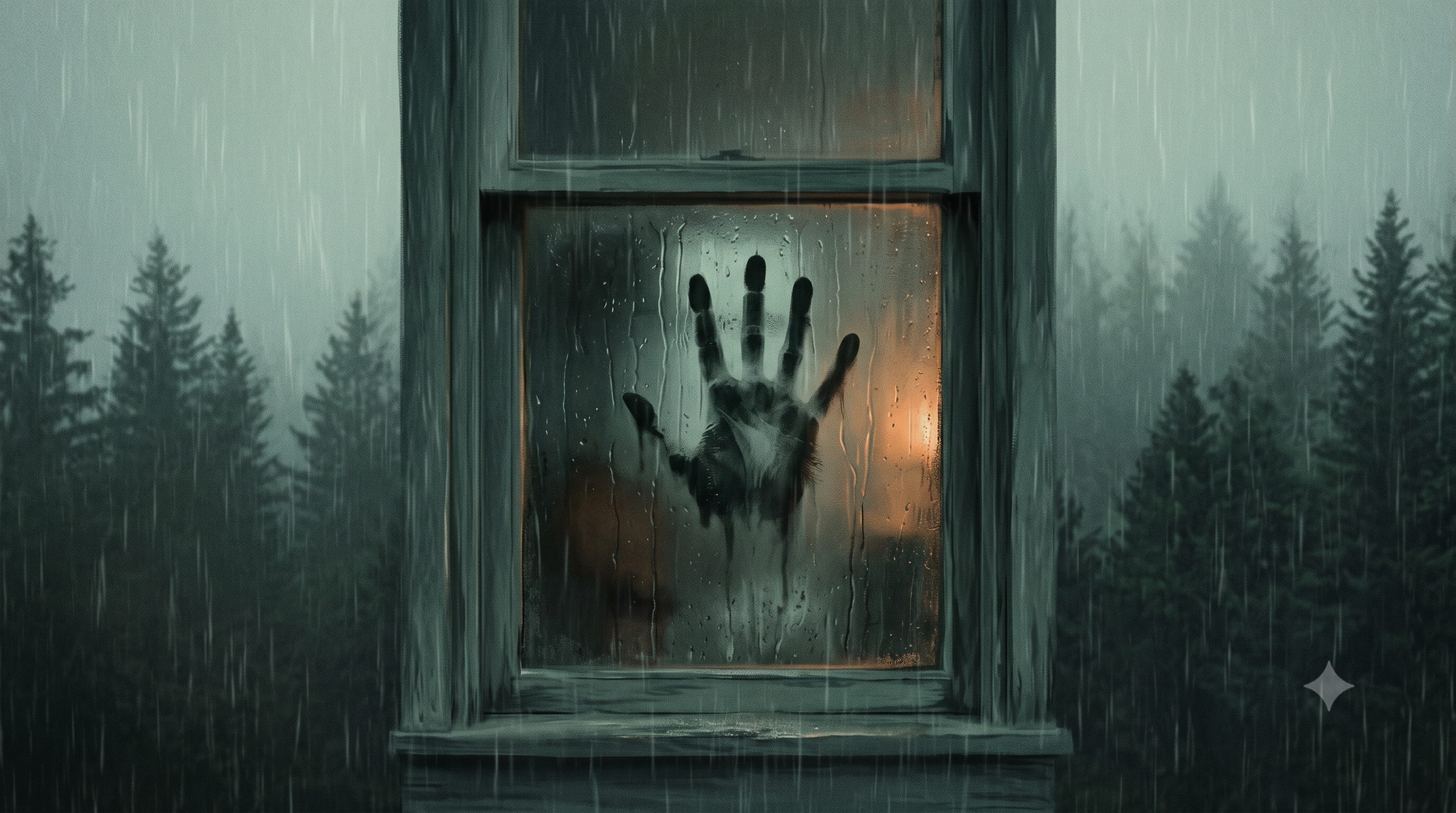
The rain started at four and by nine it had found every soft place in the house. It came down inside the walls of the back bedroom, behind the plaster, running along the studs where the flashing had rotted out years before Dale Merrick ever signed the papers. He could hear it moving in there. A wet sliding, board to board, working its way down.
He told himself it was water. Water was the honest explanation, and Dale had learned to want honest explanations after the divorce, after the lawyer, after the year that took his marriage and his savings and left him a house he could afford only because no one else in the county would touch it.
Nadine was seven. She had the small room at the back because she liked the window, the one that looked out over the tree line. She said you could watch the woods breathe. Dale never corrected her. Some of the things a child says are truer than a grown man wants them to be, and he had stopped arguing.
She called him a little before nine. Not a scream. A flat voice, the one she used when she was working hard to make something sound like nothing.
“Daddy. There’s a girl at my window.”
He was down the hall before he finished hearing it.
The room was dark except for the mushroom nightlight throwing weak orange across the floor. Nadine sat up with the blanket to her chin and her eyes on the glass, and Dale followed them and felt his body go cold from the feet up.
Something stood at the window.
The window was on the second floor. There was nothing out there to stand on but eleven feet of falling rain and then the roots of the pines. And there was a girl pressed against it anyway, close, her face nearly to the pane, one hand flat on the glass.
She wore a dress that had been white a long time ago, high at the collar, a row of small buttons down the front. The rain had soaked it black and something else had soaked it darker, blooming out from the seams and the underarms and the hollow of the throat. Her hair hung straight and heavy on both sides, parted so it covered her eyes and left only the lower half of her face.
The lower half was where the trouble was.
The skin of her jaw had split. Not torn, split, the way skin splits when the thing under it swells past what skin allows, and the edges of the splits had gone hard and gray and curled back, and in the trenches between them the flesh was the wet pink of something turned inside out. Her lips had parted at the corners and kept parting. The tears ran up into her cheeks in clean seams, and the seams did not bleed. They wept a slow clear fluid that beaded and ran and left a shine. When she breathed, and she breathed, the whole ruined lower face pulled tight and slack, tight and slack, and each time it went slack he could see the muscle working under the open places, red cords sliding over each other, wet and deliberate.
She pressed her hand harder to the glass.
The hand had too many joints. Each finger carried an extra knuckle, and the extra knuckle let the fingers fold backward at the middle so the tips lay flat against the pane while the rest of the hand stood up off it, a spider going down on its legs. The pads of the fingers were black and split like the jaw, and where they touched the glass they left prints, dark, glistening, spreading at the edges. The nails had lifted. He could see the pale beds beneath them, and he could see that beneath the beds there was movement, a small crawling fullness, as if the girl were packed with something that had run out of room.
Nadine had gone quiet. When Dale looked, his daughter was not watching the window anymore. She was watching him, to see what a father did about a thing like this.
“Get behind me,” he said.
He made himself cross the room. Every animal part of him wanted the truck and the road and eleven miles of dark between them and this, but the road was rain and mud and he was not sure the thing at the glass would stay at the glass once his back was turned. So he crossed to the window and he looked, and through the running water her one visible eye found him under the curtain of hair.
The eye was clean. That was what took the floor out from under him. All that ruin, the split jaw, the seeping seams, the fingers folding the wrong way, and set into the middle of it was an ordinary brown eye, a child’s eye, wet and terrified, looking out of the wreckage the way a person looks out of a car going into deep water.
Her torn mouth moved. Through the glass and the rain he heard it, small and clear, pitched exactly like his daughter’s.
“Let me in. I’m so cold.”
His hand was on the latch.
He looked down and his own fingers had turned the brass lever halfway and he did not remember deciding to. He pulled the hand back like it belonged to someone else and flattened it on the sash and held the window shut. On the other side the girl tipped her head, and where her neck bent the skin gave along a fold, and the fold opened, and inside the fold, packed in tight, was a mass of something soft and gray and finely veined, the underside of a mushroom, and it flexed once in the wet before the skin closed over it again.
“You know me,” she said. “You knew me. Let me in.”
“I don’t know you,” Dale said. His voice came apart in the middle.
“You will.”
She smiled.
The seams at the corners of her mouth ran up her face and split wider as the smile spread, the flesh parting in long clean lines all the way to the hinges of her jaw, and the jaw dropped, and it kept dropping, lower than a jaw is hung to go, and inside there were teeth. Rows of them. Small, white, a child’s baby teeth, and behind that row another row, and behind that another, going back and down a throat that had teeth where a throat has none, hundreds of them set in wet red gum, all of them turned outward, all of them toward him. The smell came through the shut window, standing water and turned meat and under it something floral gone sour, violets left to rot in the vase.
Behind him Nadine said, flat and careful, “Daddy, she’s the girl in the picture.”
He did not turn. “What picture, baby?”
“In the wall. There’s a hole behind the closet. There’s a box.”
She had found the crawl space he sealed the day they moved in. Four screws and a sheet of plywood, because a child does not need a hole in her wall. She had worked one corner loose over the summer the way children do, patient past all reason, and inside was a shoebox, and inside the box a photograph, a girl in a white dress at the edge of the trees, and writing on the back. A year. A name.
“It says 1961,” Nadine said. “It says her name. It’s my name too. It says Nadine.”
At the window the thing set its second hand to the glass beside the first. Both palms now, all those folded fingers spread, and it leaned its weight in. The old glass bowed. Dale saw the putty crack in the corners and heard the pane give a thin rising note as it flexed toward the room, and he understood that a single sheet of glass was the only thing between his daughter and eleven feet of dark and the mouth that opened past the edges of its own face.
He grabbed Nadine off the bed. Got her under one arm and backed toward the door, and the girl at the window watched him go with her head cocked and her weeping seams shining in the orange light, and she said the thing he was still trying to say three days later when they found what was left of him.
“You already let me in. I came down through the walls all summer, one board at a time, in the water. I’ve been under your house and inside your house and in the space behind your daughter’s clothes. This is the last window. I’m only knocking to be kind.”
The glass did not break.
It gave.
He saw it in the half second before he got the door shut. The pane lost its hardness the way fat loses its hardness in a warm hand, going soft and slow and clear, and her fingers pushed into it, not through it, into it, sinking to the second knuckle in the surface of the window, and the whole sheet took the shape of her hands and pulled her in after them, and where she passed the glass sealed shut behind her without a mark, and she was standing in the room, dripping, small, her bare feet on the crushed nightlight, that one clean eye swinging around to find them.
“There you are,” she said.
Dale got as far as the kitchen.
He put Nadine down and shoved her at the back door and told her to run to the truck, and the child ran, and that was the last order his body followed as his own. Because the girl came into the kitchen behind him without hurry, and she reached up with one of those wrong hands and took him by the wrist, and the fingers folded around his arm the wrong way, all the way around, past where a hand should close, and where she gripped him his skin went cold, and then the cold went in.
It ran up the arm. He watched it move. Under the skin of his forearm the muscle began to shift, the red cords loosening from the bone and sliding, rearranging, and the skin split along the top the way hers had split, clean, gray at the edges, and the split did not bleed. It wept. His hand at the end of the arm was already changing, the knuckles doubling, a fresh joint rising under the skin of each finger with a small wet click he felt in his teeth, and the fingers bent back on themselves and lay flat and easy against the counter, spider on its legs.
He tried to scream and his jaw came unhinged. He felt it drop past where it was hung, felt the seams tear up his cheeks in two clean lines, felt his lips part at the corners and keep parting, and inside his own mouth he felt new teeth push up through the gum in rows, small and white and turned outward, more of them and then more, packing back into a throat that made room by growing what it needed. His hair, what little a fifty-year-old man keeps, poured down over his face all at once, black with a wet that came from inside him, and it hung straight on both sides and curtained his eyes, and behind the curtain his eyes, both of them, stayed exactly as they were. Brown. Clear. His own. Watching out of all of it, terrified, while the rest of him became a thing that opened doors from the outside.
The girl stood beside him and held his rearranged hand in hers, palm to folded palm, and looked up at what he was now with something that on a whole face would have been tenderness.
“Now you’ll want to be let in too,” she said. “That’s the worst part. You’ll stand at the glass and you’ll be so cold and you’ll watch them not open it, and you’ll understand exactly why they can’t, and you’ll knock anyway. Everyone here knocks. There’s a whole yard of us at the tree line, knocking, all polite.”
Nadine lived. No one could account for it. They found her locked inside the truck, dry in all that rain, too small to have reached the locks, a shoebox in her lap. She did not speak for a long time. When she finally did, years on, to a woman paid to listen, she said only that she looked back once from the truck and saw two of them standing in the orange light of the kitchen. Two now. Matching white dresses, though one of them had been her father an hour before and wore the dress the way a big man wears a small thing, seams open, jaw hung wrong, hair down over an ordinary set of eyes. They were holding hands. They turned together and looked at her through the kitchen window, both faces ruined, both pairs of eyes clean and brown and begging, and she understood that they were not angry with her.
They only wanted to know why she got to be on the outside.
The house is still out there. The county holds it for back taxes and cannot sell it. Every so often someone comes down the dirt road faster than they went up, pale, unwilling to say much, only that there was a face at the upstairs window. A girl. That she put her hand to the glass and left a dark print that spread. That the skin of her was not right, that the mouth went too far, that the smell reached them from behind sealed glass.
And that the thing they could not shake, standing out there in the rain with an animal telling them to run, was how badly some quiet part of them had wanted to reach up and open the window.
Just to get her out of the cold.
Ok. Now I’m officially worried about you. As always, amazing writing…but like Aria said…geez! 😱
Your writing is so clever and cinematic. Where do you get your ideas from?