
The Last Regular
A Short Story

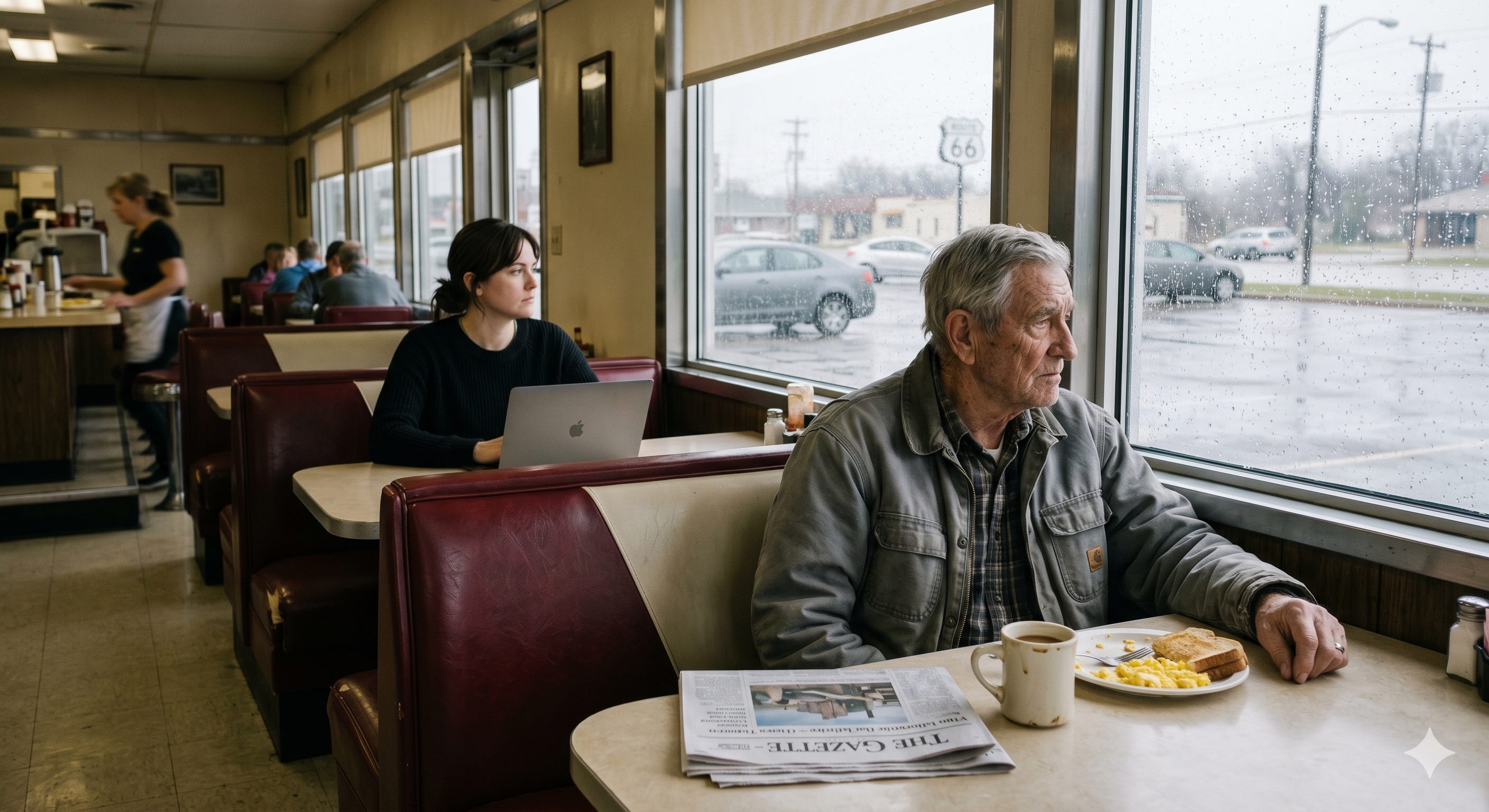
The booth by the window had belonged to Walter Pruitt for eleven years. Not legally. Not in writing. But Carla knew, and the morning crew knew, and even the new dishwasher who’d been there six weeks already knew, because Carla had told him on his second day: don’t bus that table before eight-fifteen because the old man in the gray jacket hasn’t left yet.
Walter came in at seven. He ordered the same thing every time: two eggs over easy, wheat toast, black coffee, and orange juice from the carton, not the fresh-squeezed. He’d tried the fresh-squeezed once, in 2019, and told Carla it tasted like someone had rubbed the inside of a garbage disposal with a citrus peel. She’d written it on the back of a receipt and taped it inside the hostess stand as a reminder.
On a Tuesday in October, the booth next to his was taken by a woman he didn’t recognize. Mid-thirties, maybe. Dark hair pulled back with one of those clips that looked like it was losing the argument. Laptop open. Coffee going cold beside her keyboard while she stared at the screen with the expression of someone who had just received a diagnosis.
Walter ate his eggs. Read his newspaper. The actual paper, not a phone. He got it from the stand on the corner every morning, paid with exact change, nodded at the man behind the glass who never spoke but always nodded back. He’d been doing this since 1987, and he did not intend to stop.
At eight o’clock, the woman made a sound. Not a word. Not a sob. A low, compressed exhale, the kind that lives behind the sternum for an hour before it finally escapes. She closed the laptop, put both hands flat on the table, and stared out the window at the parking lot the way people stare at parking lots when they’re not really looking at the parking lot.
Walter folded his newspaper to the crossword and said, without looking up, “Fourteen down is meridian. In case you’re working on it.”
She blinked. Looked over. “I’m not doing the crossword.”
“I know. But you looked like you needed someone to say something that wasn’t about whatever’s on that computer.”
She stared at him for a beat. Then she laughed. It surprised her, that laugh. She pressed her fingers to her mouth like she was trying to put it back. “That’s a strange thing to say to someone you don’t know.”
“I’m seventy-eight,” Walter said. “I’ve used up my strange things to say budget.”
Her name was Nina. She taught high school English three miles north and had been sitting in this diner for forty-five minutes trying to write a letter of resignation she couldn’t finish because finishing it would make it real, and she wasn’t sure she was ready for it to be real.
Walter listened. He did not offer advice. He did not tell her what she should do, what he would do, or what his daughter, who was a lawyer, would recommend. He drank his coffee. He let her talk. This was a skill he’d spent about sixty years not having and the last fifteen trying to acquire.
“My husband says I should just quit,” she said. “That I’ve given enough. Twenty-two years. He says twenty-two years is enough for anything.”
“Is he wrong?”
She pulled at a paper napkin, not tearing it, just folding the corners. “No. That’s the problem.”
Walter set down his coffee. Outside, a delivery truck backed into the lot, beeping. A sparrow landed on the sill and looked through the glass with the specific contempt only small birds and teenagers can manage.
“My wife taught second grade for thirty-one years,” Walter said. “When she retired, she cried for a week. I thought I’d done something wrong. Turned out she was crying because she was going to miss the kids. Then she cried a second week because she realized she wasn’t going to miss the staff meetings.”
Nina smiled. “What did she do after?”
“Planted a garden. Read every book she’d been putting off. Drove me crazy for about a month until she found her rhythm.” He paused. “She died four years ago. February. But she got eleven good years after she left that school. Eleven years she wouldn’t have had if she’d stayed until she had nothing left.”
Nina was quiet for a moment. The restaurant hummed around them: the scrape of a chair, the hiss of the griddle, Carla refilling coffee at the counter without being asked, moving the way people move when they’ve done the same job long enough that the job has become part of their body.
“I’m sorry about your wife,” Nina said.
“Thank you.” He meant it simply, without the complicated weight that condolences usually carry when they’re four years overdue. “Her name was Ruth. She was funnier than me and she knew it, which made her insufferable, which I miss every single day.”
Nina opened her laptop again. Walter went back to his crossword. They didn’t speak for another ten minutes, but the silence had changed quality, the way a room changes when someone opens a window.
At eight-twelve she closed the laptop, gathered her things, and stood up. She looked at the screen one more time. Then she looked at Walter.
“Did Ruth finish the letter?” she asked. “When she retired?”
“She wrote it on a Tuesday. Handed it in on Wednesday. Said there was no point in carrying it around once it was done.”
Nina nodded. Pulled on her coat. Left twelve dollars on the table for a nine-dollar coffee, which Carla would notice and remember.
At the door, she stopped. “Thank you,” she said. “For the crossword help.”
“Fourteen down,” Walter said, not looking up. “Don’t forget.”
She pushed through the door. The little bell above it rang once. Walter watched the parking lot for a moment, then looked down at his newspaper. He already knew meridian. He’d filled it in before she sat down.
He stayed until eight-fifteen. He always did.
If this landed for you, there’s more on the shelf. Follow The Proud Boomer on Substack for fiction, opinion essays, and the newsletter:

Paid subscriptions are $5 a month or $50 a year. Full archive, one exclusive piece per month, no sponsored content, no algorithm. Just more of this. And if something here stays with you, reach out: john@theProudBoomer.com -- John.