

The Processing Floor
Some thresholds you don't stand at twice

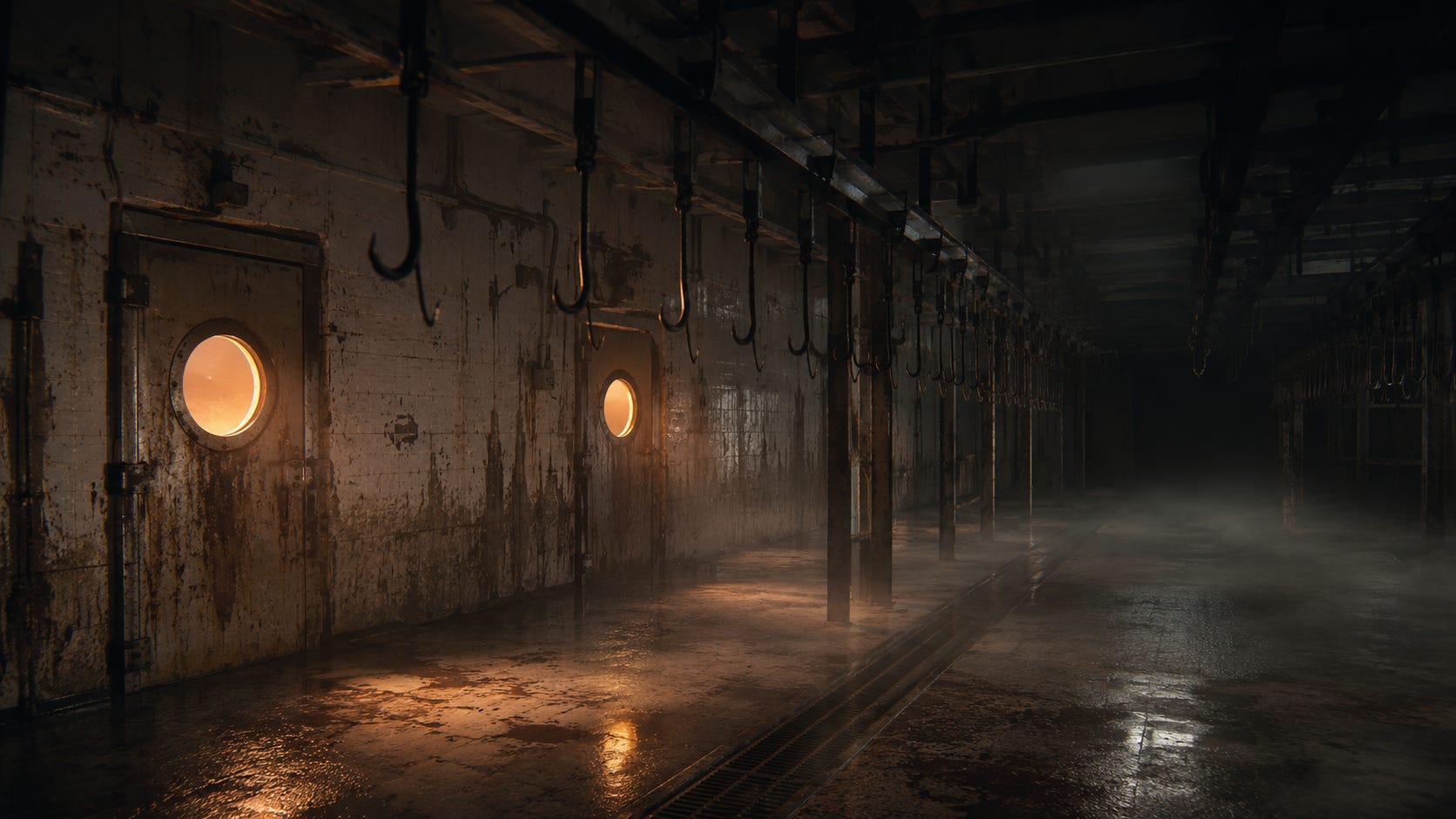
The smell reached Danny Pruett three hundred yards before the building did.
Not the clean copper of fresh blood, which was the lie they told you in the first week. The real smell was older than that. It was what happened after blood dried and then got wet again, what happened when the fat from ten thousand carcasses soaked into concrete and the concrete stopped being concrete and became something else entirely. Something that breathed. The USDA inspector had once told Danny that the smell never left you, that you could scrub your skin down to the pink and your wife would still roll away from you in bed, and Danny had nodded like this was news.
He’d worked the floor at Meade Brothers Processing for eleven years. He knew what he was.
It was a Thursday in late November, and the morning fog was sitting low over the Apalachicola floodplain, pressing down on the cinderblock walls of the facility like something alive. The parking lot lights were still on at 5:45 a.m., buzzing their sodium orange into the dark. Danny locked his truck, pulled his hard hat from the seat, and didn’t look at the building. There was a way of entering that involved not looking directly at it. He had learned this by accident and now he couldn’t stop doing it.
Inside, the pre-shift noise was already going. The kill floor was two rooms east of the processing floor, separated by a set of swinging steel doors with porthole windows, and through those windows you could see the overhead chain moving, always moving, even when nothing hung from it. Danny had stopped looking through those windows around year three. There were things you filed away and things you didn’t.
He clocked in. Suited up. Walked to his station at the secondary table, where the trimming happened, where you took what came down the line after the primary cuts, and you made it presentable.
This was the work.
Raul was already at the table across from him, working his knife along his steel without looking up. Raul had been here longer than Danny and had fewer words for it, which Danny had come to understand was not a personality trait but a kind of wisdom. You got quiet when you were in the presence of something you couldn’t name.
“Cold in here,” Danny said.
Raul ran the blade again. “Always cold.”
The line started at six.
The thing Danny noticed first was that the chain was running slow.
Not broken. Not stopped. Just wrong, the way a second hand on a clock moves wrong when the battery is starting to die. Like something was thinking about each inch before allowing it.
He noticed it at 8:22, when he looked up from the table to take a piece from the line and the carcass that should have been there was three feet back from where it should be. He looked left toward the kill floor doors. The porthole windows were fogged.
That was new.
By 9:15, the fog inside the windows had turned the color of old teeth, and nobody else seemed to notice it, and Danny was not the kind of man who said anything about what he noticed in here. There was an etiquette to the floor. You did not name things. You did not make them real by speaking them.
At 9:47, the carcass that came down to him moved.
Not a twitch. Not a post-mortem spasm of muscle, which he had seen before and knew the science of. This was something with intent behind it. The foreleg extended toward him the way you extend a hand in greeting, slow and deliberate, and the joint where the shoulder had been cut rotated toward him, and the exposed interior of the chest cavity opened slightly, like a mouth.
Danny set his knife on the table.
He looked at Raul. Raul was watching the floor drain.
He looked at Carla down the line, and Luis behind her, and Marcus at the trim table, and none of them were moving, all of them watching their own particular nothing, and the chain was still running at its wrong slow speed, and the smell in the room had changed to something older than the usual smell, something underneath the usual smell, the smell that the usual smell had always been a cover for.
He put his hand out and touched the carcass.
It was warm.
Not residual heat. Not the warmth of recent death. This was a living warmth, the warmth of something in continuous process, something ongoing and purposeful, and when his fingers touched the exposed meat of the chest cavity he felt the tissue move against his hand with a kind of welcoming pressure, a slow gathering, and he understood that this was not one animal but all of them, all the years of them, the accumulated protein of his eleven years of work, and it had been waiting, patient in the way that only the truly hungry can be patient, learning his hands.
He tried to pull back.
The tissue held him by three fingers.
He didn’t scream because the floor had that etiquette and also because when he opened his mouth what came out was not sound but the same wet warmth that was holding his hand, and he understood with the clarity that only comes at the very end of something that he had been on the line much longer than he knew. That the line went in both directions. That what he had been trimming for eleven years and what had been watching him through eleven years of porthole windows were the same thing, curious about him the way he had never thought to be curious about it.
The chain ran slow.
The fog pressed against the windows.
Raul watched the floor drain.
Danny Pruett went down the line.
The USDA inspector who came through at noon noted in his report that Station 7 was unmanned, which happened, and that the floor drain near Station 7 had been recently cleaned, which was unusual for mid-shift. He noted the fog on the kill floor windows. He ate his lunch in his car and did not finish it and drove the forty minutes back to Tallahassee with the windows down and the heat off and when his wife asked him that night how his day was he said fine, just tired, the usual.
He did not go back.
Some thresholds, once you’ve stood at them, you don’t stand at again.
But the chain kept running. It always kept running.
Slow and warm and patient, the way the truly hungry always are.
The Proud Boomer Dispatch publishes Southern Gothic horror and literary fiction that gets under your skin and stays there. If this one worked on you, consider becoming a paid subscriber at johnsproudboomer.substack.com — $20/month, $80/year, and worth every cent if dark fiction is your thing.
Once again, I read this in the morning instead of before bed. Yikes! I need more coffee, but after reading this I’m afraid to go out into the kitchen! You get me every time! Your writing is just too real.
Could really smell the slaughter house, scary place.
As a child there was a processing house quite near, and we used to drive around there with our bikes, there was a certain kind of feeling there, consisting of the smell, and mostly of our thoughts what was happening inside the house.